



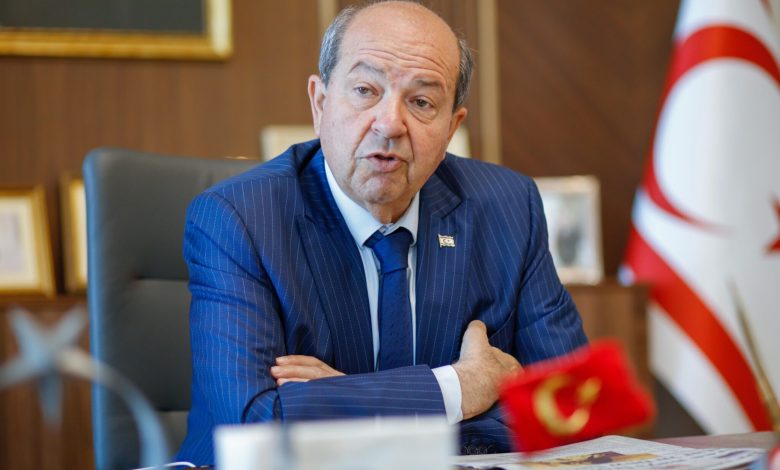
President Ersin Tatar has issued a written statement in response to the visit of Johannes Hahn, who has been appointed as the European Union’s Special Representative for Cyprus.
Tatar emphasized that the Turkish Cypriot side rejects any approach based on exclusion, unilateralism, or fait accompli. He stated that the appointment of Hahn is an internal matter for the EU, and no contact or engagement would take place within this framework.
In his statement, President Tatar recalled that, after the prolonged insistence of the Greek Cypriot leader, the EU took an internal decision to appoint Johannes Hahn as the Special Representative for Cyprus.
Tatar criticized this move, emphasizing that it was made without the consent of the Turkish Cypriot side and ignored their will.
He also pointed out that the Greek Cypriot leader presented Hahn’s appointment as a personal victory and tried to equate Hahn with the United Nations Secretary-General’s Personal Representative.
Tatar underlined that such an approach is not only unrealistic but also disrespectful to the ongoing work under the UN framework.
He further stated that the EU’s internal arrangement serves the political objectives of the Greek Cypriot side, lacking neutrality, and completely disregards the sovereign will of the Turkish Cypriot people.
He reiterated that the Cyprus issue is continuing within the framework of six initiatives agreed upon in Geneva, under the auspices of the United Nations Secretary-General and María Ángela Holguín, the UN Secretary-General’s Personal Representative.
Tatar emphasized that any effort outside this process, not based on the equal consent of both parties, undermines cooperation efforts. The European Union is not a party to this process and cannot be part of any equation on Cyprus without the approval of the Turkish Cypriot side.
Tatar concluded by making it clear that the appointment of Hahn is an EU internal matter and that there will be no contact or engagement with him within this context.
He further stated that the EU institutions, if they truly seek to restore relations between the two sides, should encourage the Greek Cypriot leader to reconsider his aggressive policies, which have damaged bilateral relations.
The Turkish Cypriot people, according to Tatar, are steadfast in advocating for a solution based on sovereign equality and equal international status and will not accept any exclusionary, unilateral, or fait accompli-based approaches.
BRT


